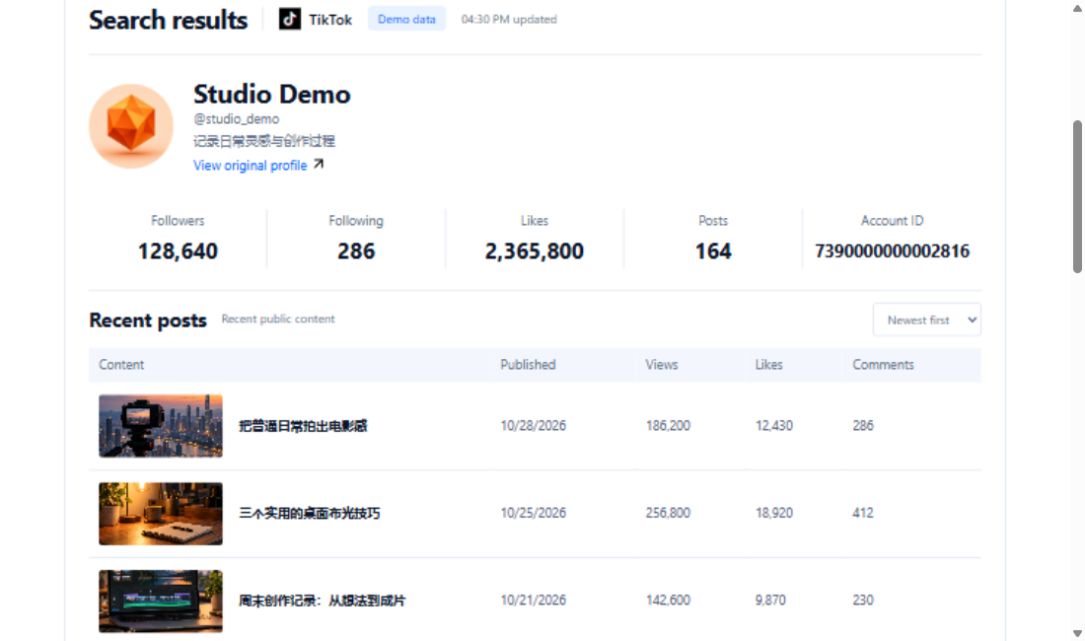
You have saved several fitness creators for a yoga-mat launch. The useful question is whether they can clearly demonstrate how the product fits into someone’s routine.
TRMesh helps organize public profiles and recent posts. Fees, audience geography and usage rights still require direct confirmation with the creator.

List the actions viewers should see
Rolling the mat for storage, opening it in a small room and performing a few ordinary movements are clearer requirements than “make a viral video.” Product claims must come from information you can substantiate.
Look for creators whose framing shows the floor and whose work demonstrates movement. A comedy-focused fitness account may still fit, but do not assume it offers the same production style.
Confirm the account and review recent work
Start with the full profile request below, then use the documented post-list endpoint. Retain source links and dates. Inspect a small set first to confirm it is the creator’s own published work.
Note openings, setting, camera clarity, spoken language and disclosed collaborations. Describe observations. Comment language alone cannot establish the audience’s country distribution.
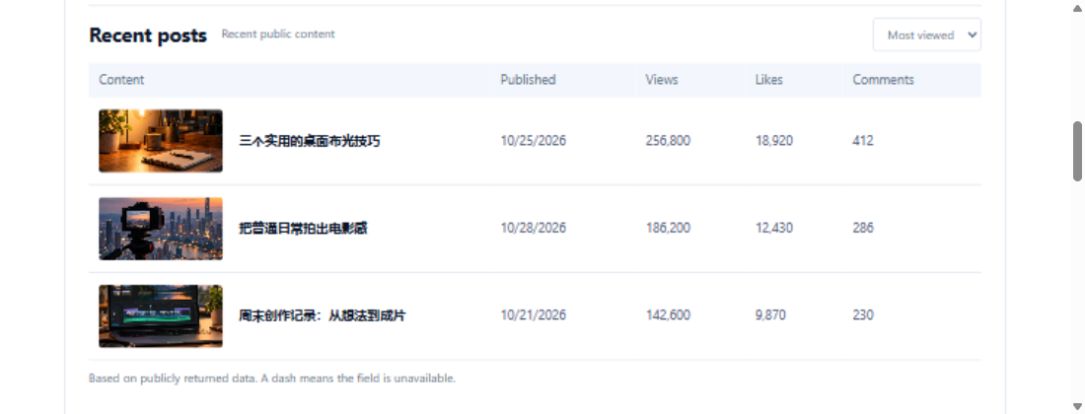
Do not turn the highest view count into a forecast
A standout video may have benefited from an unusual event. Record it separately and look for repeatable presentation skills in comparable posts. New and older videos have had different time to accumulate engagement.
Leave unavailable metrics missing rather than filling them with zero and silently penalizing a candidate.
Convert observations into a brief
This is a planning worksheet, not a message already sent:
| Area | What to clarify |
|---|---|
| Use case | Home practice in a small space, opening and storing the mat |
| Accurate information | Dimensions, material and supported product claims |
| Creative freedom | Opening, camera choices and personal delivery |
| Delivery and rights | Quantity, format, date and permitted use to agree |
| Open questions | Space, availability, fee and revisions |
If a previous post shows useful framing, explain why: an overhead view makes foot placement clear. Do not ask for another creator’s finished video to be copied or promise comparable views.
Keep delivery and results as separate records
Record the published link, date and whether agreed deliverables were met. Separately record observation time, visible engagement and business outcomes you can verify. Avoid collapsing them into one supposed creator-value score.
Clear content with little traffic raises a distribution question. Traffic with unclear product information raises a content or landing-page question. Those distinctions are more actionable than simply calling a creator effective or ineffective.
Requests used in this project
- Get information of specified user:https://api.trmesh.com/openapi/api/v1/tiktok/app/v3/handler_user_profile · Documentation
- Get user homepage video data V1:https://api.trmesh.com/openapi/api/v1/tiktok/app/v3/fetch_user_post_videos · Documentation
- Get single video data:https://api.trmesh.com/openapi/api/v1/tiktok/app/v3/fetch_one_video · Documentation
Request URL and parameters
GET https://api.trmesh.com/openapi/api/v1/tiktok/app/v3/handler_user_profile
| Parameter | Type | Required | Meaning |
|---|---|---|---|
user_id |
string | No | User uid (optional, pure number) |
sec_user_id |
string | No | User sec_user_id |
unique_id |
string | No | User unique_id (username) |
Run the Python example
Install requests and set TRMESH_API_TOKEN in your environment. Replace the sample identifiers with the public object you intend to inspect. Example IDs may no longer be available.
import os
import requests

# Read your own developer key from the server environment.
url = "https://api.trmesh.com/openapi/api/v1/tiktok/app/v3/handler_user_profile"
params = {
    "sec_user_id": "MS4wLjABAAAAv7iSuuXDJGDvJkmH_vz1qkDZYo1apxgzaxdBSeIuPiM"
}
response = requests.get(
    url, params=params, timeout=30,
    headers={"Authorization": f"Bearer {os.environ['TRMESH_API_TOKEN']}"},
)
response.raise_for_status()
payload = response.json()
print(payload)  # Inspect the actual response before mapping fields
Endpoint documentation · Free profile tool
API calls use your TRMesh account allowance. Check the endpoint price before running a script.