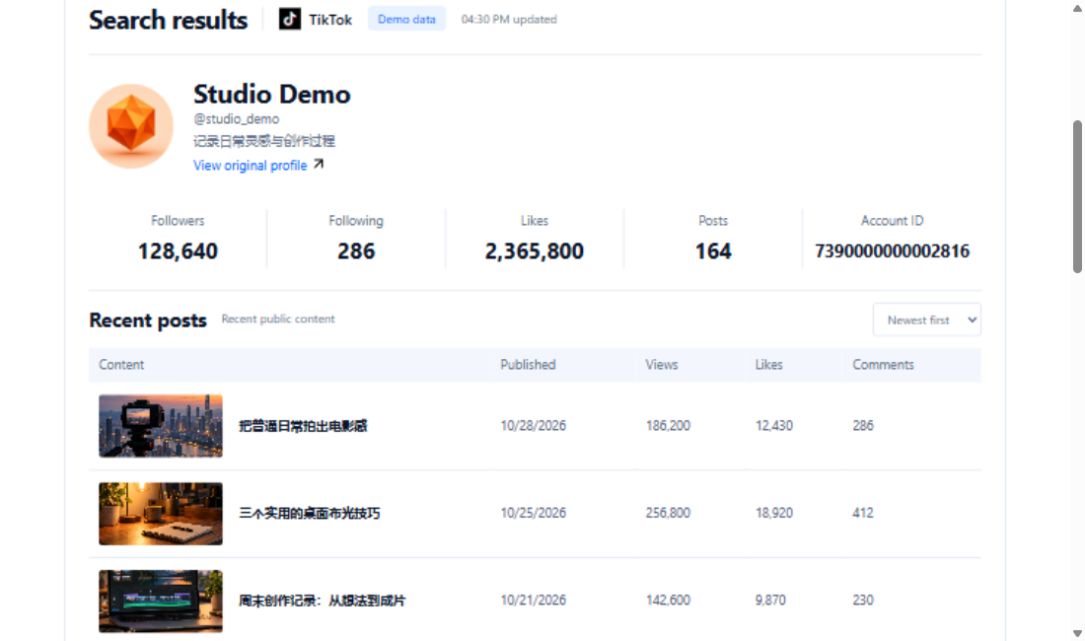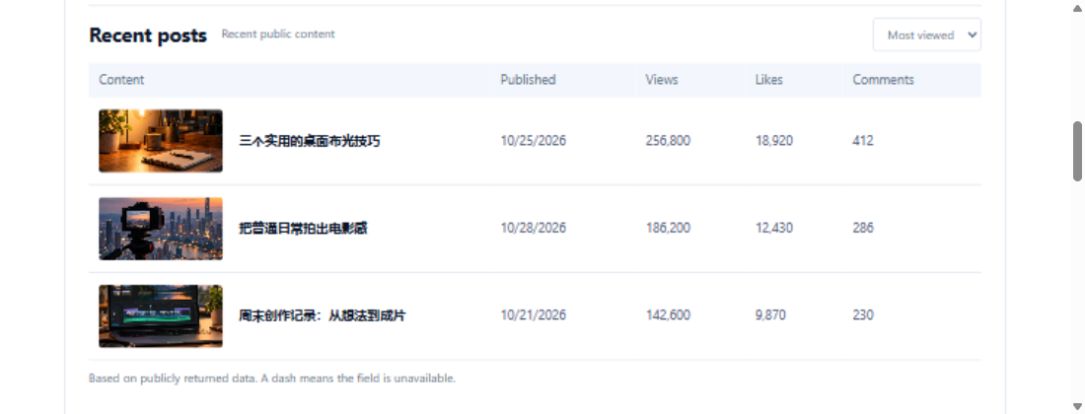
Choose the creative period you want to understand
Before discussing next month’s ideas with a creator, review a sequence of posts instead of judging one viral example. A hypothetical brief might cover kitchen demonstrations published during September. The user-post list runs from newest to oldest, so it supports working backward through that period. It does not decide which subjects are effective or evaluate production quality for you.
Remove overlap before counting posts
Use the account’s secUid and keep count at fifteen or fewer. Continue with the returned cursor while hasMore indicates another page. Adjacent pages can contain duplicate posts; deduplicate by post id before reporting a total. The deprecated post_item_list_request_type parameter no longer changes the order and should not be treated as a way to request a popularity ranking.
Turn viewing notes into an editorial discussion
Maintain a reading sheet with a post identifier, source link, observation date, and your own topic notes. Two hypothetical pan-cleaning videos might receive different annotations: one demonstrates a sequence, while the other explains a principle. Those annotations are human judgments, not supplied classifications. State the pages and dates covered, and mark unavailable items separately so an incomplete collection never becomes an unsupported claim about the creator’s entire history.
Request URL and parameters
GET https://api.trmesh.com/openapi/api/v1/tiktok/web/fetch_user_post
| Parameter | Type | Required | Meaning |
|---|---|---|---|
secUid |
string | Yes | User secUid |
cursor |
integer | No | Page cursor |
count |
integer | No | Number per page, max 15 |
coverFormat |
integer | No | Cover format |
post_item_list_request_type |
integer | No | Sort type (deprecated, no longer effective) |
Run the Python example
Install requests and set TRMESH_API_TOKEN in your environment. Replace the sample identifiers with the public object you intend to inspect. Example IDs may no longer be available.
import os
import requests

# Read your own developer key from the server environment.
url = "https://api.trmesh.com/openapi/api/v1/tiktok/web/fetch_user_post"
params = {
    "secUid": "MS4wLjABAAAAv7iSuuXDJGDvJkmH_vz1qkDZYo1apxgzaxdBSeIuPiM",
    "cursor": "0",
    "count": "15",
    "coverFormat": "2",
    "post_item_list_request_type": "0"
}
response = requests.get(
    url, params=params, timeout=30,
    headers={"Authorization": f"Bearer {os.environ['TRMESH_API_TOKEN']}"},
)
response.raise_for_status()
payload = response.json()
print(payload)  # Inspect the actual response before mapping fields
Endpoint documentation · Free profile tool
API calls use your TRMesh account allowance. Check the endpoint price before running a script.