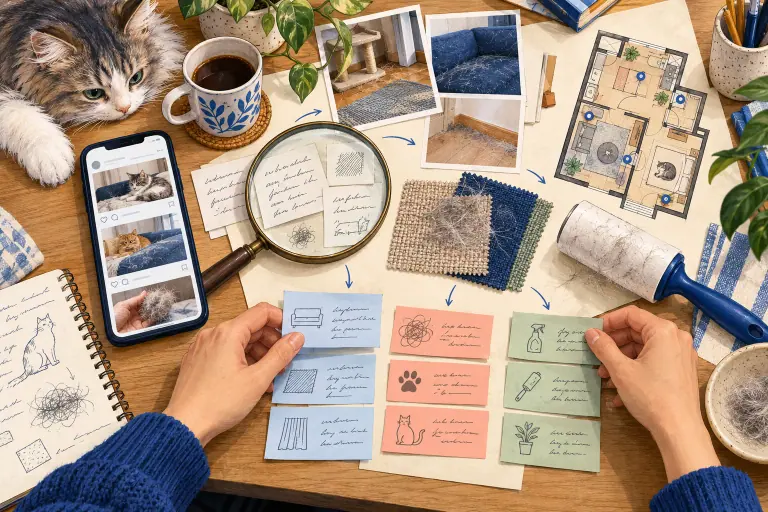
You finished reorganizing a desk, but a borrowed writing template makes the story sound like someone else's experience. Begin with your actual problem, decisions and unfinished issues.
Inventory your own evidence
List photos, measurements, supplies and the steps you performed. Separate completed work from future plans. Do not invent a precise budget without records or a long-term result after brief use. Build material cards that each paragraph can trace back to.
Use references to discover questions
Search related notes and inspect the appropriate details. Notice questions about cable routing, dimensions or room constraints. Those questions may improve your explanation, but another author's supplies and experiences must not become yours. Avoid assembling the draft from copied passages.
Follow your actual decision sequence
Explain the original difficulty, choice, actions, result and remaining limitations in an order that suits the experience. If AI drafts from your material cards, require unknown information to remain unresolved and every first-person claim to come from supplied facts.
Check text against photographs
Verify dimensions, quantities and timing, removing unsupported effects. Ask an uninvolved reader whether the conditions are clear. The search endpoint does not itself create original experience or guarantee later performance. Deliver a supported draft and a list of missing material, gathering evidence before turning an unfinished plan into a claim of completion.
Requests used in this project
- Search notes:https://api.trmesh.com/openapi/api/v1/xiaohongshu/app_v2/search_notes · Documentation
- Get image note detail:https://api.trmesh.com/openapi/api/v1/xiaohongshu/app_v2/get_image_note_detail · Documentation
- Get video note detail:https://api.trmesh.com/openapi/api/v1/xiaohongshu/app_v2/get_video_note_detail · Documentation
Request URL and parameters
GET https://api.trmesh.com/openapi/api/v1/xiaohongshu/app_v2/search_notes
| Parameter | Type | Required | Meaning |
|---|---|---|---|
keyword |
string | Yes | Search keyword |
page |
integer | No | Page number, start from 1 |
sort_type |
string | No | Sort type |
note_type |
string | No | Note type: 不限, 视频笔记, 普通笔记, 直播笔记 |
time_filter |
string | No | Time filter: 不限, 一天内, 一周内, 半年内 |
search_id |
string | No | Search ID for pagination |
search_session_id |
string | No | Search session ID for pagination |
source |
string | No | Source |
ai_mode |
integer | No | AI mode: 0=off, 1=on |
Run the Python example
Install requests and set TRMESH_API_TOKEN in your environment. Replace the sample identifiers with the public object you intend to inspect. Example IDs may no longer be available.
import os
import requests

# Read your own developer key from the server environment.
url = "https://api.trmesh.com/openapi/api/v1/xiaohongshu/app_v2/search_notes"
params = {
    "keyword": "美食推荐",
    "page": "1",
    "sort_type": "general",
    "note_type": "不限",
    "time_filter": "不限",
    "source": "explore_feed",
    "ai_mode": "0"
}
response = requests.get(
    url, params=params, timeout=30,
    headers={"Authorization": f"Bearer {os.environ['TRMESH_API_TOKEN']}"},
)
response.raise_for_status()
payload = response.json()
print(payload)  # Inspect the actual response before mapping fields
Endpoint documentation · Free profile tool
API calls use your TRMesh account allowance. Check the endpoint price before running a script.