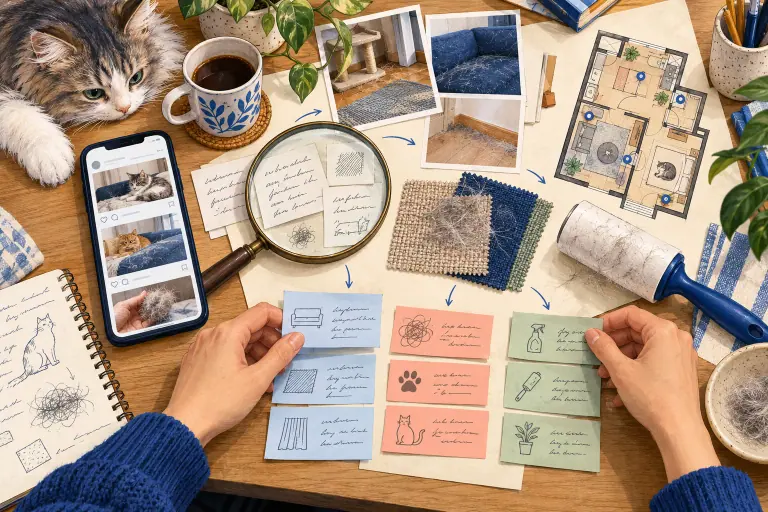
Complaints about cat hair might suggest a new cleaning tool or a weekend cleaning service. Both sound plausible. Neither is proved by the existence of complaints.
This exercise uses TRMesh research to create a one-page opportunity assessment and a small pilot. The business is hypothetical; there are no real orders or claimed success results.

Write an assumption that could be wrong
“Pet care has potential” cannot be tested. Try “would nearby cat owners with fabric sofas pay for a convenient one-off hair-removal service?” That specifies a person, situation and job. If existing tools are already satisfactory, you know which assumption failed.
Keep three columns under the assumption: supporting material, contrary material and unanswered questions. Allowing a negative answer prevents research from becoming a collection of compliments for your idea.
Search for the problem, then for alternatives
First search for cat hair, sofas and cleaning services. Then search for removal tools and existing solutions. Read a small set of relevant originals before retrieving more pages. The full TRMesh search URL and sample request appear below.
Keyword research requires developer access. The free homepage looks up profiles; it does not generate a business plan. A non-developer can begin with a manual sheet and automate the repetitive retrieval later.
Give objections a place in the assessment
These are illustrative possibilities, not findings:
| Clue | Implication | Small test |
|---|---|---|
| Repeated cleaning takes too long | A service might save effort | Observe one complete cleaning session |
| A cheap roller works well enough | Not every owner needs help | Ask what would make them switch |
| A stranger entering the home is a concern | Trust may matter more than price | Explain tools, scope and booking clearly |
| Deep cleaning happens before moving | Demand may be occasional | Test a single service before a subscription |
Do not discard “I can do it myself.” It may save you from turning an occasional task into an elaborate ongoing service.
Ask the AI for a reasoned assessment
Provide selected records and ask:
List reasons to try this service and reasons to wait. Cite source IDs. Separate explicitly stated needs from our assumptions. Identify the three missing facts that would most affect the decision. Do not invent market size, success probability or revenue.
Check the argument. A complaint about peeling roller sheets does not establish willingness to book a home visit. That requires another conversation.
Plan a pilot small enough for one weekend
Write a service description before building a booking app: suitable surfaces, included tasks, exclusions, expected duration and how to reserve. Work out pricing from your real time, supplies and travel costs rather than copying an example price.
Before a trial, agree on materials, method and cost. Afterwards, ask which actions felt worth paying for. Recruit willing participants through channels you may use, not unsolicited bulk comments under research posts.
Decide what the test actually changed
Record booking interest, completed appointments, time, cost and willingness to use the service again. Many inquiries without a booking can indicate unclear scope, a price mismatch or weak demand. Inquiry count alone is not success.
If people mainly want a compact tool, consider a small product trial. If they need help only before moving, test a one-off service. Keep the source sheet, one-page assessment and a concrete pilot schedule. These are more useful for the next decision than a long automatically generated report.
Topic inspiration: a Xiaohongshu business-idea validation project. This is an original TRMesh workflow, not a distribution of that project or a claim to its results.
Request URL and parameters
GET https://api.trmesh.com/openapi/api/v1/xiaohongshu/app_v2/search_notes
| Parameter | Type | Required | Meaning |
|---|---|---|---|
keyword |
string | Yes | Search keyword |
page |
integer | No | Page number, start from 1 |
sort_type |
string | No | Sort type |
note_type |
string | No | Note type: 不限, 视频笔记, 普通笔记, 直播笔记 |
time_filter |
string | No | Time filter: 不限, 一天内, 一周内, 半年内 |
search_id |
string | No | Search ID for pagination |
search_session_id |
string | No | Search session ID for pagination |
source |
string | No | Source |
ai_mode |
integer | No | AI mode: 0=off, 1=on |
Run the Python example
Install requests and set TRMESH_API_TOKEN in your environment. Replace the sample identifiers with the public object you intend to inspect. Example IDs may no longer be available.
import os
import requests

# Read your own developer key from the server environment.
url = "https://api.trmesh.com/openapi/api/v1/xiaohongshu/app_v2/search_notes"
params = {
    "keyword": "美食推荐",
    "page": "1",
    "sort_type": "general",
    "note_type": "不限",
    "time_filter": "不限",
    "source": "explore_feed",
    "ai_mode": "0"
}
response = requests.get(
    url, params=params, timeout=30,
    headers={"Authorization": f"Bearer {os.environ['TRMESH_API_TOKEN']}"},
)
response.raise_for_status()
payload = response.json()
print(payload)  # Inspect the actual response before mapping fields
Endpoint documentation · Free profile tool
API calls use your TRMesh account allowance. Check the endpoint price before running a script.